|
************************************************************
NTSB Cites Flight Crew Failures in Crash of Airplane Carrying
Senator Wellstone, 7 Others
************************************************************
Washington, DC (18 Nov 03) - The National Transportation Safety
Board today determined that the probable cause of the crash late
last year of a Raytheon (Beechcraft) King Air 100 airplane, carrying
Senator Paul Wellstone and seven others, was the "flight crew's
failure to maintain adequate airspeed, which led to an aerodynamic
stall from which they did not recover."
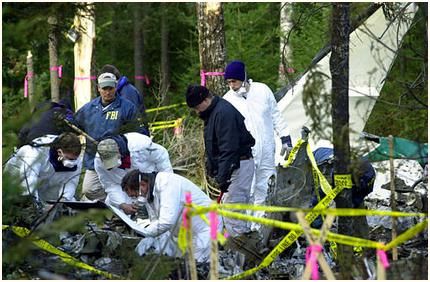
The airplane, operated by Aviation Charter, Inc., was on a flight
from St. Paul to Eveleth, MN, when it crashed, on October 25, 2002,
on approach to the Eveleth-Virginia Municipal Airport. The airplane
was destroyed and there were no survivors.
"This tragic accident that took the lives of a respected U.S.
Senator, members of his family, staff, and the flight crew, shocked
us all," said NTSB Chairman Ellen G. Engleman.
"It sadly and starkly points out the need for more aggressive
action to improve safety in the on-demand charter industry."
Reviewing the results of the extensive investigation into this
accident, NTSB Members concluded that the flight crew failed to
maintain an appropriate course and speed for the
approach to Eveleth and did not properly configure the airplane at
the start of approach procedures.
"During the later stages of the approach," the Board said, the
flight crew "failed to monitor the airplane's airspeed and allowed
it to decrease to a dangerously low level (as low as about 50 knots
below the company's recommended approach speed) and to remain below
the recommended approach speed for about 50 seconds." The airplane
then entered a
stall from which it did not recover.
The Board judged that while cloud cover might have prevented the
flight crew from seeing the airport, icing did not affect the
airplane's performance during the descent. Cockpit instrument
readings on course alignment and airspeed should have prompted the
flight crew to execute a go-around.
The Board did not find indications of any preexisting medical or
other physical condition that might have adversely affected the
crew's performance during the accident flight. Crew fatigue also
does not appear to have been a factor in the accident. A review of
flight crew records and interviews with co-workers, the Board said,
indicated that both pilots had "previously demonstrated serious
performance deficiencies consistent with below-average flight
proficiency." There was no clear evidence as to which crewmember
was the flying pilot at the time of the accident.
The Board determined that the accident airplane was properly
certificated, equipped and maintained in accordance with Federal
regulations. The recovered components showed no
evidence of preexisting powerplant, system or structural failures.
The Board also concluded that the out-of-tolerance condition and
slight bends in the Eveleth-Virginia airport VOR signal were not a
factor in this accident.
With respect to the operator, the Board found that Aviation Charter,
Inc., was not making crewmembers sufficiently aware of its Standard
Operating Procedures, and also cited the
company's failure to provide adequate stall recovery guidance.
Further, the company was not training its pilots in crew resource
management in accordance with its FAA-approved training program.
Consequently, the Board recommended that the FAA make such training
mandatory for Part 135 on-demand charter companies that conduct
dual-pilot operations.
The Board, noting that FAA surveillance of Aviation Charter, Inc.,
was not sufficient to detect the discrepancies that existed at the
company, recommended that the agency conduct en route inspections
and observe training and proficiency checks at all Part 135
on-demand charter operations, as is done at Part 121 and Part 135
commuter operations, to ensure the adequacy, quality and
standardization of pilot training and flight operations.
Additionally, the Board recommended that the FAA convene a panel of
experts to determine the feasibility of a requirement for the
installation of low-airspeed alert systems in airplanes engaged in
commercial operations under Parts 121 and 135, and act accordingly
on the panel's findings.
A synopsis of the accident investigation report, including the
findings, probable cause, and safety recommendations, can be found
on the Publications page of the Board's web
site,
http://www.ntsb.gov.
The complete report will be available in about six weeks.
|
![[First]](bw2_first.gif)
![[Prev]](bw2_prev.gif)
![[Index]](bw2_index.gif)
![[Next]](bw2_next.gif)
![[Last]](bw2_last.gif)