| Date: | 10 FEB 1978 |
| Time: | 16.50 PST |
| Type: | Beechcraft 99 |
| Operator: | Columbia Pacific Airlines |
| Registration: | N199EA |
| Msn / C/n: | U- 37 |
| Year built: | 1968 |
| Engines: | 2 Pratt & Whitney Canada PT6A-20 |
| Crew: | 2 fatalities / 2 on board |
| Passengers: | 15 fatalities / 15 on board |
| Total: | 17 fatalities / 17 on board |
| Location: | near Richland, WA (USA) |
| Phase: | Climb |
| Nature: | Domestic Scheduled Passenger |
| Departure airport: | Richland, WA |
| Destination airport: | Seattle, WA |
| Flightnumber: | 23 |
Remarks:
The aircraft lifted off at a point of 1173ft-1486ft down the runway and was
then seen to begin a steep climb at an angle of 20-45deg. to 300ft-400ft
height. The plane then turned left and descended nose-down at a flightpath
angle of about 45deg. until it struck the ground 1669ft past the runway end
and caught fire.
PROBABLE CAUSE:
"The failure and inability of the flightcrew to prevent rapid pitchup and
stall by exerting sufficient push force on the control wheel. The pitchup
was induced by the combination of a mistrimmed horizontal stabilizer and a
center of gravity near the aircraft's aft limit. The mistrimmed condition
resulted from discrepancies in the aircraft's trim system and the
flightcrew's probable preoccupation with making a timely departure.
Additionally a, malfunctioning stabilizer trim actuator detracted from the
flightcrew's efforts to prevent the stall. Contributing to the
accident were inadequate flightcrew training, inadequate trim warning system
check procedures, inadequate maintenance procedures, and ineffective FAA
surveillance."
Maintenance -
Substandard practices (general)
Source: (also check out
sources used for
every accident)
NTSB-AAR-78-15
 Accident
Investigation Report NTSB-AAR-78-15 [PDF 1,1 MB]
Accident
Investigation Report NTSB-AAR-78-15 [PDF 1,1 MB]
| Date: | 24 FEB 1999 |
| Time: | 16.34 |
| Type: | Tupolev 154M |
| Operator: | China Southwest Airlines |
| Registration: | B-2622 |
| Msn / C/n: | 90A-846 |
| Year built: | 1990 |
| Engines: | 3 Soloviev D-30KU-154-II |
| Crew: | 11 fatalities / 11 on board |
| Passengers: | 50 fatalities / 50 on board |
| Total: | 61 fatalities / 61 on board |
| Location: | Ruian (China) |
| Phase: | ..Approach |
| Nature: | Domestic Scheduled Passenger |
| Departure airport: | Chengdu Airport (CTU) |
| Destination airport: | Wenzhou Airport (WNZ) |
| Flightnumber: | 4509 |
Remarks:
The aircraft was on a flight from Chengdu to Wenzhou and was approaching
Wenzhou when, at 1000m, the flaps were extended. At that moment, the
aircraft suddenly pitched down and dove into the ground out of control. The
Tupolev crashed into a farm field and exploded, causing a 200x100ft hole in
the ground. Several farmers were injured by the flying debris. PROBABLE
CAUSE: A self-locking nut, other than castle nut with cotter pin as
specified, had been installed at the bolt for connection between pull rod
and bellcranck in the elevator control system. The nut screwed off,
resulting in bolt loss, which led to the loss of pitch control.
Related information/accidents:
Maintenance - Wrong
installation of parts
Airplane - Flight
surfaces - Elevator
Result - Crash out of
control
| Date: | 11 SEP 1991 |
| Time: | 10.03 |
| Type: | Embraer 120RT Brasilia |
| Operator: | Jet Link/Continental Express |
| Registration: | N33701 |
| Msn / C/n: | 120077 |
| Year built: | 1987 |
| Total airframe hrs: | 7229 hours |
| Cycles: | 10009 cycles |
| Crew: | 3 fatalities / 3 on board |
| Passengers: | 11 fatalities / 11 on board |
| Total: | 14 fatalities / 14 on board |
| Location: | Eagle Lake, TX (USA) |
| Phase: | Descent |
| Nature: | Domestic Scheduled Passenger |
| Departure airport: | Laredo International Airport, TX (LRD) |
| Destination airport: | Houston-Intercontinental Airport, TX (IAH) |
Remarks:
Embraer 120 N33701 was pulled into the Continental Express hangar at Houston
around 21.30h for scheduled maintenance which included removal and
replacement of both left and right hand horizontal stabilizer deice boots.
The second shift mechanics started working on the right hand deice boot.
Although planned for the third shift, the 47 screws from the top of the left
leading edge assembly for the horizontal stabilizer were already removed by
the second shift. The third shift mechanics finished the replacement of the
right hand deice boot but did not have time to replace the left hand boot as
well. The first flight was a 07.00h scheduled flight from Houston to Laredo.
Flight 2574 departed Laredo for the return leg to Houston at 09.09h. The
cruise portion of the flight was uneventful and at 10.03h the aircraft was
descending through 11800ft to 9000ft when the air loads caused the left
horizontal stabilizer leading edge to bend downward and separate. A sudden
severe nose down pitchover occurred and the wings stalled negatively. A
negative g of 3.5 was recorded by the FDR. Eyewitnesses reported a bright
flash and saw the aircraft breaking up while descending in a flat left spin
until impact.
PROBABLE CAUSE: "The failure of Continental Express maintenance and
inspection personnel to adhere to proper maintenance and quality assurance
procedures for the airplane's horizontal stabilizer deice boots that led to
the sudden in-flight loss of the partially secured left horizontal
stabilizer leading edge and the immediate severe nose-down pitchover and
breakup of the airplane. Contributing to the cause of the accident was the
failure of the Continental Express management to ensure compliance with the
approved maintenance procedures, and the failure of FAA surveillance to
detect and verify compliance with approved procedures."
NTSB board member John K. Lauber filed a dissenting statement on the
investigation report, believing the probable cause should read as follows:
"1) The failure of Continental Express management to establish a corporate
culture which encouraged and enforced adherence to approved maintenance and
quality assurance procedures, and 2) the consequent string of failures by
Continental Express maintenance and inspection personnel to follow approved
procedures for the replacement of the horizontal stabilizer deice boots.
Contributing to the accident was the inadequate surveillance by the FAA of
the Continental Express maintenance and quality assurance programs."
Follow-up / safety actions::
The NTSB made 2 recommendations during the investigation (on February 28,
1992). Recommendation A-92-6 asked the FAA to enhance flight standard
surveillance of Continental Express. Recommendation A-92-7 called for
actions to enhance flight standard Program Guidelines, including the
National Aviation Safety Inspection Program (NASIP). Following the
investigation 2 other recommendations were issued.
Maintenance -
Substandard practices (general)
Maintenance -
Substandard practices (general)
Source: (also check out
sources used for
every accident)
NTSB/AAR-92/04; ASW 4.1.93(4); CNN 15.09.91; FI 18-24.09.91; Scr; NTSB
Safety Recommendations A-62-7 and -7 + A-92-79 and -80; ICAO Adrep Summary
1/95
 Accident
Investigation Report NTSB/AAR-92/04 [PDF 2,1 MB]
Accident
Investigation Report NTSB/AAR-92/04 [PDF 2,1 MB]
| Date: | 25 MAY 1979 |
| Time: | 15.04 CDT |
| Type: | McDonnell Douglas DC-10-10 |
| Operator: | American Airlines |
| Registration: | N110AA |
| Msn / C/n: | 46510/22 |
| Year built: | 1972 |
| Total airframe hrs: | 19871 hours |
| Engines: | 3 General Electric CF6-6K |
| Crew: | 13 fatalities / 13 on board |
| Passengers: | 258 fatalities / 258 on board |
| Total: | 271 fatalities / 271 on board |
| Ground casualties: | 2 fatalities |
| Location: | Chicago-O'Hare International Airport, IL (ORD) (USA) |
| Phase: | Take-off |
| Nature: | Domestic Scheduled Passenger |
| Departure airport: | Chicago-O'Hare International Airport, IL (ORD) |
| Destination airport: | Los Angeles International Airport, CA (LAX) |
| Flightnumber: | 191 |
Remarks:
Flight 191 left the gate at Chicago-O'Hare at 14.59h and taxied to runway
32R. At 15.02h the flight was cleared for takeoff. The takeoff roll was
normal until just before rotation at which time sections of the No. 1 engine
pylon structure came off the aircraft. During rotation the entire No.1
engine and pylon separated from the aircraft, went over the top of the wing,
and fell to the runway. Flight 191 lifted off about 6,000 ft down the
runway, climbed out in a wings level attitude, and reached an altitude of
about 300ft agl with its wings still level. Shortly thereafter, the aircraft
began to turn and roll to the left, the nose pitched down, and the aircraft
began to descend. As it descended, it continued to roll left until the wings
were past the vertical position. The DC-10 crashed in an open field and
trailer park about 4,680 ft northwest of the departure end of runway 32R.
The aircraft was demolished during the impact, explosion, and ground fire.
Two persons on the ground were killed.
PROBABLE CAUSE: "The asymmetrical stall and the ensuing roll of the aircraft
because of the uncommanded retraction of the left wing outboard leading edge
slats and the loss of stall warning and slat disagreement indication systems
resulting from maintenance-induced damage leading to the separation of the
no.1 engine and pylon assembly procedures which led to failure of the pylon
structure. Contributing to the cause of the accident were the vulnerability
of the design of the pylon attach points to maintenance damage; the
vulnerability of the design of the leading edge slat system to the damage
which produced asymmetry; deficiencies in FAA surveillance and reporting
systems which failed to detect and prevent the use of improper maintenance
procedures; deficiencies in the practices and communications among the
operators, the manufacturer, and the FAA which failed to determine and
disseminate the particulars regarding previous maintenance damage incidents;
and the intolerance of prescribed operational procedures to this unique
emergency."
Related information/accidents:
Maintenance
Airplane - Engines -
Separation
Result - Crash out of
control
Source: (also check out
sources used for
every accident)
NTSB Safety Recommendations A-79-98/105 + NTSB-AAR-79-17
Accident
Investigation Report NTSB-AAR-79-17 [PDF 5,5
| Date: | 27 APR 1977 |
| Type: | Convair CV-440 |
| Operator: | Aviateca |
| Registration: | TG-ACA |
| Msn / C/n: | 143 |
| Year built: | 1954 |
| Crew: | 6 fatalities / 6 on board |
| Passengers: | 22 fatalities / 22 on board |
| Total: | 28 fatalities / 28 on board |
| Location: | near Guatemala City (Guatemala) |
| Phase: | Initial Climb |
| Nature: | Scheduled Passenger |
| Departure airport: | Guatemala City-La Aurora Airport (GUA) |
| Destination airport: |
Remarks:
No.1 engine failure due to oil exhaustion. The prop couldn't be feathered
and the aircraft crashed while making an emergency landing in rough terrain.
PROBABLE CAUSE: No.1 engine cylinders and oil-high pressure hose not
correctly reconnected after maintenance.
| Occurrence: Accident Damage: Written off Status: Final |
| Date: | 30 JUL 1998 |
| Time: | 11.05 |
| Type: | HAL/Dornier 228-201 |
| Operator: | Alliance Air |
| Registration: | VT-EJW |
| Msn / C/n: | 8075/HAL1007 |
| Year built: | 1986 |
| Crew: | 3 fatalities / 3 on board |
| Passengers: | 3 fatalities / 3 on board |
| Total: | 6 fatalities / 6 on board |
| Ground casualties: | 2 fatalities |
| Location: | Kochi (India) |
| Phase: | Initial Climb |
| Nature: | Domestic Scheduled Passenger |
| Departure airport: | Kochi Airport (KCZ) |
| Destination airport: | Thiruvananthapuram |
| Flightnumber: | 503 |
Remarks:
The HAL-manufactured Dornier 228 was operating on a flight from Agathi to
Thiruvananthapuram via Kochi (Cochin). On takeoff from Kochi an engine
reportedly caught fire. The plane then nose-dived into an aircraft
components repair shed on the Southern Naval Command yard, killing two
persons on the ground. The captain had a flying experience of 5366 hours
(2271 of which as a pilot-in-command on the Dornier). PROBABLE CAUSE: "The
Committee has concluded that poor aircraft maintenance practices at Short
Haul Operations Department contributed to the accident. After take off, the
aircraft pitched up uncontrollably, stalled, fell to its right and crashed.
The uncontrollable pitch up was caused by sudden uncommanded downward
movement of the Trimmable Horizontal Stabilizer leading edge. This was due
to partial detachment of its actuator forward bearing support fitting due
non-installation of required hi-lok fasteners. "
| Date: | 02 FEB 1995 |
| Time: | 00.08 |
| Type: | Boeing 737-2A1 |
| Operator: | VASP |
| Registration: | PP-SMV |
| Msn / C/n: | 20968/367 |
| Year built: | 1974 |
| Engines: | 2 Pratt & Whitney JT8D-17 |
| Crew: | 0 fatalities / 7 on board |
| Passengers: | 0 fatalities / 121 on board |
| Total: | 0 fatalities / 129 on board |
| Location: | São Paulo-Guarulhos International Airport, SP (GRU) (Brazil) |
| Phase: | Take-off |
| Nature: | International Scheduled Passenger |
| Departure airport: | São Paulo-Guarulhos International Airport, SP (GRU) |
| Destination airport: | Buenos Aires/Ezeiza-Ministro Pistarini Airport, BA (EZE) |
Remarks:
Boeing 737 PP-SMV departed Sao Paulo-Guarulhos for a flight to Buenos Aires.
Following flap retraction the nr. 3 flap 'in transit' light remained on and
the crew noticed some other problems: they were not able to reduce nr.2
engine thrust below 1.15 EPR and the A hydraulic system suffered a pressure
loss. An emergency return was made and the aircraft touched down on runway
09L at 185kts, flaps at 15deg. The 737 overran the runway by 200m and came
to rest following a collapse of the nosegear and right hand main gear. It
appeared that the nr. 3 leading edge flap actuator attachment fitting on the
wing front spar had fractured due to corrosion. The actuator came away and
caused the failure of some hydraulic lines and damage to the thrust control
cables. Some 1981 Boeing Service Bulletins had not been complied with. One
of these included the replacement of the aluminium leading edge flap
actuator attachment fitting with a steel one; this had not been done. Hull
hulk now used as fire trainer.
| Date: | 26 APR 1994 |
| Time: | 20.16 |
| Type: | Airbus A.300B4-622R |
| Operator: | China Airlines |
| Registration: | B-1816 |
| Msn / C/n: | 580 |
| Year built: | 1990 |
| Total airframe hrs: | 8572 hours |
| Cycles: | 3910 cycles |
| Engines: | 2 Pratt & Whitney PW4158 |
| Crew: | 15 fatalities / 15 on board |
| Passengers: | 249 fatalities / 256 on board |
| Total: | 264 fatalities / 271 on board |
| Location: | Nagoya-Komaki (NGO) (Japan) |
| Phase: | Landing |
| Nature: | International Scheduled Passenger |
| Departure airport: | Taipei-Chiang Kai Shek Airport (TPE) |
| Destination airport: | Nagoya-Komaki (NGO) |
| Flightnumber: | 140 |
Remarks:
The Airbus took off from Taipei for a flight to Nagoya where it arrived over
the Outer Marker at 20.12:26h. The 1st officer started the runway 34 ILS-approach
with auto throttles engaged. At an altitude of 1070ft (at 145kts and 5
degrees pitch) he inadvertently selected TOGA (Take Off Go Around) mode.
Unknowingly of the TOGA selection, the crewmembers tried to override the
flight director's throttle and pitch control movements. In order to remain
on the glide slope, the 1st officer disengaged the auto throttle and reduced
thrust manually. At 1030ft the crew hoped that the autopilots would get them
on the glide slope, and engaged them. The autopilot immediately entered the
go-around mode (because TOGA had been selected 12 seconds earlier) with a 18
degrees pitch up. To get back on the glide slope, the crew applied down
elevator. This caused the flight director guidance system to select pitch-up
stabilizer. Forty-two seconds after TOGA selection, the autopilots were
disengaged again, but the aircraft kept climbing. Eight seconds afterwards,
the alpha floor was activated due to an excessive angle-of-attack. Alpha
floor triggered maximum thrust, which increased the nose-up attitude to 52.6
degrees. The captain disengaged alpha-floor by retarding engine thrust. The
speed had dropped to 78kts by then, causing the Airbus to enter a stall at
1800ft. The aircraft hit the ground tail-first 300ft right of the runway and
burst into flames. The Airbus had 8550 flying hours and 3910 cycles. The
weather was fine: wind 290 degrees/6kts (varying between 230deg and 320deg)
>10 km visibility; scattered clouds at 3000ft.
CAUSES: "While the aircraft was making an ILS approach to runway 34 of
Nagoya Airport, under manual control by the F/O, the F/O inadvertently
activated the GO lever, which changed the FD (Flight Director) to GO AROUND
mode and caused a thrust increase. This made the aircraft deviate above its
normal glide path.
The APs were subsequently engaged, with GO AROUND mode still engaged. Under
these conditions the F/O continued pushing the control wheel in accordance
with the CAP's instructions. As a result of this, the THS (Horizontal
Stabilizer) moved to its full nose-up position and caused an abnormal
out-of-trim situation.
The crew continued approach, unaware of the abnormal situation. The AOA
increased the Alpha Floor function was activated and the pitch angle
increased. It is considered that, at this time, the CAP (who had now taken
the controls), judged that landing would be difficult and opted for
go-around. The aircraft began to climb steeply with a high pitch angle
attitude. The CAP and the F/O did not carry out an effective recovery
operation, and the aircraft stalled and crashed.
The AAIC determined that the following factors, as a chain or a combination
thereof, caused the accident:
- The F/O inadvertently triggered the Go lever It is considered that the design of the GO lever contributed to it: normal operation of the thrust lever allows the possibility of an inadvertent triggering of the GO lever.
- The crew engaged the APs while GO AROUND mode was still engaged, and continued approach.
- The F/O continued pushing the control wheel in accordance with the CAP's instructions, despite its strong resistive force, in order to continue the approach.
- The movement of the THS conflicted with that of the elevators, causing an abnormal out-of-trim situation.
- There was no warning and recognition function to alert the crew directly and actively to the onset of the abnormal out-of-trim condition.
- The CAP and F/O did not sufficiently understand the FD mode change and the AP override function. It is considered that unclear descriptions of the AFS (Automatic Flight System) in the FCOM (Flight Crew Operating Manual) prepared by the aircraft manufacturer contributed to this.
- The CAP's judgment of the flight situation while continuing approach was inadequate, control take-over was delayed, and appropriate actions were not taken.
- The Alpha-Floor function was activated; this was incompatible with the abnormal out-of-trim situation, and generated a large pitch-up moment. This narrowed the range of selection for recovery operations and reduced the time allowance for such operations.
- The CAP's and F/O's awareness of the flight conditions, after the PlC took over the controls and during their recovery operation, was inadequate respectively.
- Crew coordination between the CAP and the F/O was inadequate.
- The modification prescribed in Service Bulletin SB A300-22-602 1 had not been incorporated into the aircraft.
- The aircraft manufacturer did not categorise the SB A300-22-6021 as "Mandatory", which would have given it the highest priority. The airworthiness authority of the nation of design and manufacture did not issue promptly an airworthiness directive pertaining to implementation of the above SB.
Related information/accidents:
Maintenance - Failure
to follow AD and SB's
Result - Crash out of
control
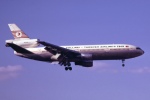
| Date: | 03 MAR 1974 |
| Time: | 11.41 |
| Type: | McDonnell Douglas DC-10-10 |
| Operator: | Türk Hava Yollari - THY |
| Registration: | TC-JAV |
| Msn / C/n: | 46704/29 |
| Year built: | 1972 |
| Engines: | 3 General Electric CF6-50D |
| Crew: | 11 fatalities / 11 on board |
| Passengers: | 335 fatalities / 335 on board |
| Total: | 346 fatalities / 346 on board |
| Location: | Bois d'Ermenonville (France) |
| Phase: | Climb |
| Nature: | International Scheduled Passenger |
| Departure airport: | Paris-Orly Airport (ORY) |
| Destination airport: | London-Heathrow Airport (LHR) |
| Flightnumber: | 981 |
Remarks:
PROBABLE CAUSE: "The accident was the result of the ejection in flight of
the aft cargo door on the left-hand side: the sudden depressurization which
followed led to the disruption of the floor structure, causing six
passengers and parts of the aircraft to be ejected, rendering No.2 engine
inoperative and impairing the flight controls (tail surfaces) so that it was
impossible for the crew to regain control of the aircraft. The underlying
factor in the sequence of events leading to the accident was the incorrect
engagement of the door latching mechanism before take-off. The
characteristics of the design of the mechanism made it impossible for the
vent door to be apparently closed and the cargo door apparently locked when
in fact the latches were not fully closed and the lock pins were not in
place. It should be noted, however that a view port was provided so that
there could be a visual check of the engagement of the lock pins. This
defective closing of the door resulted from a combination of various
factors: - incomplete application of Service Bulletin 52-37; - incorrect
modifications and adjustments which led, in particular, to insufficient
protrusion of the lock pins and to the switching off of the flight deck
visual warning light before the door was locked; - the circumstances of the
closure of the door during the stop at Orly, and, in particular, the absence
of any visual inspection, through the viewport to verify that the lock pins
were effectively engaged, although at the time of the accident inspection
was rendered difficult by the inadequate diameter of the view port. Finally,
although there was apparent redundancy of the flight control systems, the
fact that the pressure relief vents between the cargo compartment and the
passenger cabin were inadequate and that all the flight control cables were
routed beneath the floor placed the aircraft in grave danger in the case of
any sudden depressurization causing substantial damage to that part of the
structure. All these risks had already become evident, nineteen months
earlier, at the time of the Windsor accident, but no efficacious corrective
action had followed." (Aircraft Accident Report 8/76)
Related information/accidents:
Maintenance - Failure
to follow AD and SB's
Airplane - Airframe -
Cargo door
Result - Crash out of
control
Source: (also check out
sources used for
every accident)
ICAO Circular 132-AN/93 (116-125)
 |
 |
|
|