MH370 – A Most Likely Cause (Short
Synopsis)
This document = http://tinyurl.com/lh7sv2g
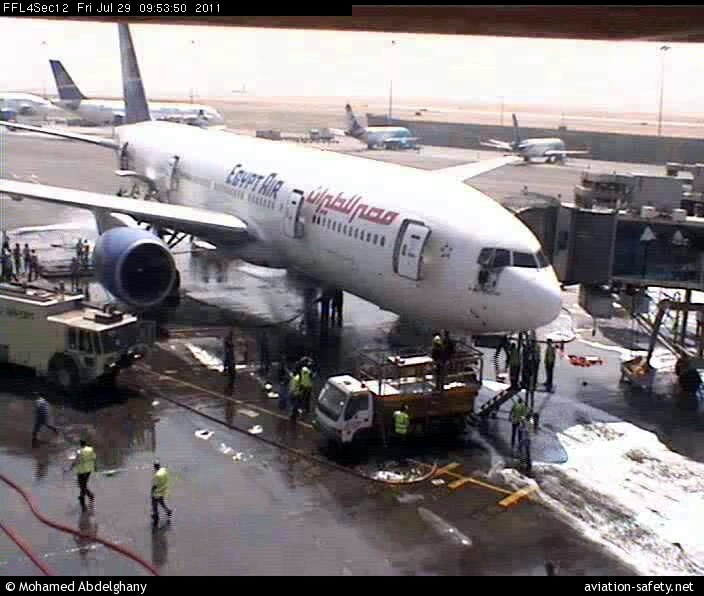
Once the oxygen flare fire of 15 to 20 seconds duration erupted in MH370's cockpit, a number of systems were affected by the melting of plastic pushbuttons (and their housings) on exposed consoles. Some keypads fused, some circuit-breakers tripped thermally and some LED screens melted, sagged and died. Some systems failed in consequence of the heat-induced compromise of the ubiquitous plastic push-buttons. However the active Flight Control system on the 777 is totally unique. That ACT-FCS has redundant redundancies. Even though one or both pilots' lungs may have been seared by the oxygen flash-fire, one of them was capable of selecting a reverse course heading to Pulau Langkawi Airport.. At some point during that turnback, as with Egyptair's 777 SU-GBP, an oxy blowtorch was created by the copilot's regulator's LP hose attachment melting (i.e. per Egyptair's SU-GBP on the Cairo ramp over 3 years earlier [report link: tinyurl.com/mwnfn3s ]). That blow-torch weakened the cockpit’s fuselage side (see imagery from Egypt's report linked at http://tinyurl.com/or9bzf2 ). See SU-GBP Report at http://tinyurl.com/oju5gyt.
|
|
|
SU-GBP destroyed by oxygen fire on the Cairo Airport Ramp on 29-07-2011 see Report: http://tinyurl.com/oju5gyt |

With the
assistance of the 4.5 psi cabin pressurization differential pressure, the
cockpit sidewall ruptured outwards causing a rapid depressurization and the
aural alarm. So the pilot flying disconnected the autopilot,
"stuffed" the nose down, but didn't manually trim it nose-down (777
pilots very rarely touch that manual trim wheel due to autotrim
- i.e. it's easily forgotten, as it was on AF447 and Air NZ's A320 stall off
Perpignan). When he then passed out due to hypoxia (mask on, but no oxygen left),
he relaxed the forward pressure on his yoke and the aircraft pitched back up
into a zoom climb, sealing the fate of all on board.
For the next seven odd hours, the MH370 ghost ship flew
on, not on autopilot but control being maintained by the flight envelope
protection built into the 777's ACT-FCS and the aircraft's inherent stability.
In essence, a 777 not on autopilot will instantly pick up a dropped wing and
(in pitch) will maintain its trimmed speed due to its highly damped phugoid. Its heading will remain static plus
or minus only a few degrees of heading - so its mean line of advance to the
Southern Ocean was quite apparently "autopiloted"
- even though it was not. As the aircraft headed south and burnt off fuel, it
would have constantly climbed, greatly improving its range. Why the tracking
changes after it overflew the Malay Peninsula? It simply flew into some
thunderheads (ITCZ being north of the Equator at that time of year) and got
spat out on a new heading, following its encounter with heavy turbulence. Once
south of the equator and clear of the InterTropic
Convergence Zone (and its 50,000 foot tall thunderheads), it would have been
flying in quite calm air and climbing through 40,000ft due to the fuel burn-off
trim change. In a 777, a ghost flight capability is quite coincidentally "built-in"
- via the characteristics of its ACT-FCS.
One of the immutable rules of aviation is that most accidents have a
precedent that, if not addressed, will eventually recur. Obviously nobody
extrapolated what had happened (on the ramp at Cairo to SU-GBP) into an
airborne context. The Cairo ramp oxygen flare did turn into a destructive 777
fire as the distracting priority for firemen was the evacuation. The airborne variant was
always going to be quite different due to pressurization and the almost
immediate loss of the oxygenated cockpit environment - once the cockpit
sidewall blew out (due to the blowtorch effect of the oxygen fire at source and
the high pressurization differential). Because a cockpit oxygen flare
doesn't have the flammables that (say) Swissair 111 had - like metallized mylar thermal acoustic batts linings and Kapton wiring insulation with its arcing/flash-over
characteristics, the residual effect would've been non-incendiary, just some
scorching and a few residual hot-spots smouldering for a short period (only) -
after the depressurization.
 |
|
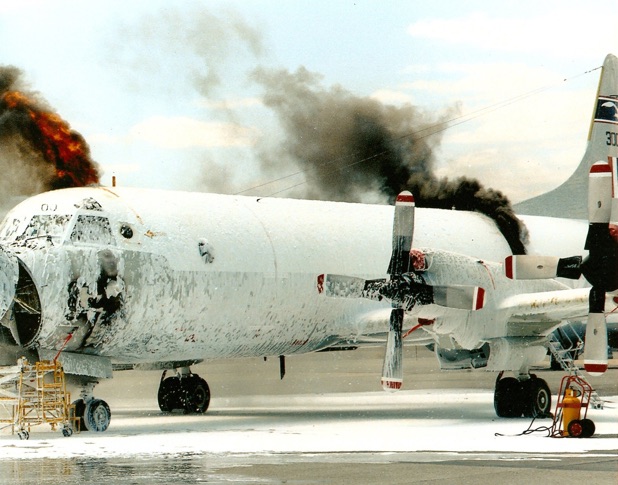
Burnt-out P3B Orion (A9-300) on the tarmac at RAAF Edinburgh after cockpit oxygen flash fire (27 Jan1984) (note hull burn-through below captain's side window). This (and the pilot’s seared lungs/lack of pilot oxygen) explains why death for all onboard MH370 followed quickly after the oxygen flare fire's flash-over eruption. |
What may have caused the oxygen flare fire to erupt at that point? If
one pilot announces his intention to leave the cockpit on a toilet break it
used to be "de rigeur" (i.e. SOP standard)
for the other pilot to haul his oxygen mask out of its housing and don it. The
original problem (a helically wound, electrically conductive stiffener wire running internally
within the LP oxy hose to stop kinking) was probably still there on the MAS 777's.
Only US registered airplanes are affected by FAA Airworthiness Directive
mandates to modify equipments. As recently as October
2014, the FAA's AD's were still playing catch-up with other Boeing airplane
types still equipped with the lethal hoses.
Were the pilots heroes then? Not really. But the villains are still identifiable and responsible for their inaction.
|
The July 2015 discovery of a relatively intact 777 flaperon from MH370 on Reunion Island tends to confirm that the aircraft ditched in an optimum attitude for ditching courtesy of the active flight control system. Despite one engine flaming out before the other due to asymmetric fuel exhaustion, the active flight control system would have: a. retained control despite some minor directional heading changes during the short period of engine asymmetry, and precluded a stall/spiral after the RAT (Ram air turbine) deployed and kicked in to power essential systems, b. maintained wings level until surface impact at a quite low gliding airspeed, c. ....thus enabling the aircraft to have floated for a short period before sinking - minus only a few shed exterior control surfaces, disrupted and displaced upon impact.
|
| this document: http://tinyurl.com/lh7sv2g |
| http://www.iasa-intl.com/folders/mh370/ShortSynopsis-MH370-itsLikelyFate.htm |
http://tinyurl.com/or9bzf2 “An_MH370_Analysis-of-Likelihoods” (full details)
The full
story is at: http://tinyurl.com/or9bzf2