By TheShadow

When a large airliner disappears and
no-one can explain why, the challenge is
for those well versed in aviation
accidents to come up with a logical and
rational explanation for such a
disaster, particularly one that seems so
unlikely in our technological age. In
the other corner are those with a vested
interest in not being subject to
potentially disastrous litigation. The
great unspoken truth is that many
stakeholders will be much better off if
the truth of the accident is never
uncovered. What normally happens is that
a company (normally Boeing, Airbus or
one of the lesser lights in airline
manufacture or even the affected airline
itself) will ultimately offer to settle
on the court steps with the litigants -
and for a lesser amount and no proven
liability, thus retain ownership of
either/all of the indepth facts, the
fiction, the speculations or the
unknowns.
But when an airliner isn't found, the victims' relatives are left in a real world of hurt, where there is no closure. Because of Global terrorism and a few suspected instances of pilot suicide, the suspicions, accusations, anger and conspiracy theories abound. However the reality is more often than not related to pilot training, inexperience or engineering. Rarely is weather or environmentals a factor. In the case of Malaysian Airlines Flight MAS370, that 777 compounded the perplexity by remaining airborne for over 6 hours after a mysterious enroute 180 degree turn and no further human communication. In fact just about all contact stopped suddenly. The mystery was based upon a continued periodic "check-in" (or handshake) with an Inmarsat satellite parked high above the Indian Ocean. The first crystal ball that an investigator consults sits atop a rule of thumb called Occam's Razor. This "tenet of truth" basically says that the simplest explanation is usually the most elegant. Basing it upon known facts or "history" strengthens that credo to a precept. This proven procedural process has been mostly overwhelmed by rampant speculation in the case of the missing MH370.
Inmarsat technicians used some rather obscure and esoteric science to plot a rough track on MH370 and led to one of the most extensive oceanic searches in the history of airline aviation ensued. Maritime patrol aircraft from 5 nations conducted continuous searches of the 180km wide arc that stretched from the point of last "handshake" to a computed fuel exhaustion splash-point somewhere NW of Perth Western Australia. Ships and robot underwater vehicles were also frustrated, being unable to locate debris or localize a few received pinger signals - assumed to be from the 777's black boxes.
Military radar contacts with the presumed 777 had it turning back then tracking across Malaysia to the Malacca Straits, meandering for a while and then turning south to track into the vast empty expanse of the Southern Indian Ocean. The challenge for investigators was to figure out just what this apparently intentional turning and assumed evasive tracking implied or how else this could be interpreted. The Malaysian Prime Minister and Transport Minister declared to the World that it was evidently a case of human interference. But is that a reasonable conclusion or could there be a more rational explanation for the events of that day? On first inspection, the inference of that 777 having been hijacked by the pilot or a third party seems rather valid and conclusive doesn't it? But could there be another version of events, one that could be related to an earlier destruction of a Boeing 777, a narrative that could explain all the events from loss of comms onward?
Let's examine one such theory and wonder whether it's a practical explanation - and if so, why it's not been surfaced thus far.
read on below:
Any Occam's Razor approach to the fate
of MH370 would be considering the oxygen
flare fire over three years ago at Cairo
airport (see imagery) - as the paramount
and pre-eminent clue. An Egyptair 777
was destroyed. This is particularly
relevant as the FAA only got around to
publishing its corresponding final rule
Airworthiness Directive in mid April
this year (well after MH370 disappeared)
- as a means of enforcing adoption of
the slightly earlier Boeing Service
Bulletin. That Cairo fire penetrated the
cockpit RHS sidewall. Airborne, this
hull rupture would have caused a rapid
depressurization - as well as quickly
allowing depressurization outflow air
(then the inflow of slipstream air) to
instantly dissipate enriched oxygen
levels and blow out any residual
smouldering .... if it had occurred
inflight at 35,000ft. After
self-extinguishing, the degree of damage
may have visually appeared quite nominal
or minimal - except for some sooting and
the pierced sidewall and one other
critical aspect for aircraft control and
communication (amplified below).
The image (see link or image below) of the Egyptair 777's seriously damaged cockpit indicates a worse fire than would have occurred airborne. This was because the Cairo firemen took a lot longer to intervene than would be acceptable elsewhere - and because the evacuation of personnel took priority.... so the fire took hold. However the oxy blowtorch effect of the fire's burning its way through the cockpit sidewall would've been the same in both cases (i.e. a blowtorch is a blowtorch at any height - as it is supported and sustained by its own oxygen supply). Don't confuse the sudden flare-up of an oxygen fire with the sort of fuel-fed sustained and spreading fire that brought down Swissair 111 (its fire was fed by airflows behind the cabin linings propagating fire courtesy of the highly flammable and ubiquitous MPET thermal acoustic insulation). The oxygen flare fire, by contrast, can be compared to an oxygenation flash-over or backdraft experienced momentarily when unwisely opening a door in a burning building. An oxygen flare fire is a very sudden onset short duration conflagration, in comparison with (say) the Swissair 111 fire. The Swissair pilots had 15 to 20 minutes from detecting fumes to their crash. Lithium Ion battery sustained inflight fires have always had similar slow-time onsets.
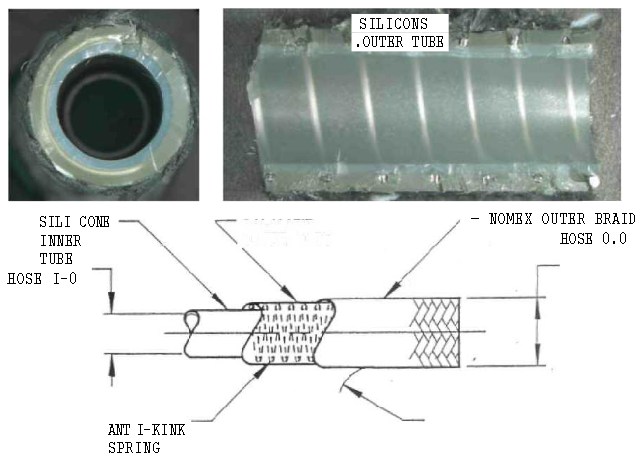
However the MH370 pilots may have been instantly burnt alive in their seats if both had been seated at the time of a wiring short-initiated oxygen fire. Oxy fires can peak at very high lung-searing temperatures - but subside quickly. The effect upon plastic components can be distortive to the point of meltdown. It's a function of peak temperature not just exposure time. The culprit was as simple as having utilized an electrically conductive stiffener wire in the interior of the pilots' oxy-hoses (i.e. a wire-spring helically wound inside a low-pressure oxygen hose to allow it to stretch and corner without a flow-limiting collapse or kink). But its use permitted a chafe-induced wiring short. This conclusion was reached quickly by the Cairo investigators - but maybe the luck stopped there? One has to wonder whether Boeing's whizz-kidz considered what may have occurred if airborne. Did they model or conceptualize that possibility? Was the Boeing Service Bulletin implemented on MH370 - i.e. did they change those concertina hoses or was it merely a suggested inspection for any anomalies - and low-priority scheduled for the next major servicing? Accidents tend to emphasize causal solutions but once that challenge is resolved, all involved de-prioritize the remedial cures until after a "proper" cost-benefit analysis and a program of Monte Carlo "repeatability and reproducibility" processing simulations. Fixes cost money and are universally unpalatable in commercial aviation. Suggested visual inspections (for chafing, say) constitute an "easy out" means of resolution. This can be seen time and time again in Service Bulletins and their formalizing EASA and FAA airworthiness directives. The underlying weasel philosophy is that (tongue in cheek) "prevention is better than cure". But admittedly, some cures can introduce their own indeterminate bugs.
See the links below for discussion of the ramifications of an inflight oxygen fire. Most significant amongst these is the effect that such a fire would have upon the type of pedestal mount, glareshield and overhead console plastic pushbutton and rotary switch controls that you find in modern aircraft. These plastic pushbuttons and their recess surrounds can quickly melt differentially, distort and become non-functional in highly elevated temperatures of as little as 10 to 15 seconds exposure (the rough duration of an oxygen flare-up fire). By comparison, the metal toggle switches of yesteryear would've been relatively invulnerable to any such flash fire.
Note also that some switches are momentary contact (such as an R/T push-to-talk), some are electrically or mechanically latched by button depression (ON/OFF), others are rotary and some may function via permitting a pull-in solenoid to complete a permanent ground to an earth. Other types may be fused together by a fire or even actuated (such as in a keypad's partial meltdown). It's a complex matter sorting out which pushbutton and its parent system would be affected (i.e. which systems would be activated, which de-activated and which would simply be rendered inoperative (i.e. disempowered) or just made inoperable)..... by a plastic pushbutton melting and/or any distortion of its housing. Much would depend upon the plastic pushbutton's distance from the seat of the fire and any intermediate shielding effect. It's an imponderable that's not yet been a known factor in a modern day aviation incident or accident. Meltdowns have (to-date) been incidental and noteworthy - but not causative.
Whatever the sudden cascade of disruptions to MH370's systems may have been, they can best be explained by the predations of an oxygen flash-fire. It is likewise unsurprising that a ghost flight would be the consequence of such an event - due to either the death/incapacitation of the pilots, the inability to control or communicate (due melted pushbuttons and fire-crazed and sooted displays or LED read-outs) ..... or simply the very restrictive time of useful consciousness once depressurization occurs at 35,000 feet (i.e. a T.U.C. that is measured in mere seconds). However one of the seated pilots (or one re-entering the flight-deck with a portable oxy-set) may have been able to pre-select a roll-out heading for Pulau Langkawi (nearest available civil airport) before ultimately succumbing to hypoxia or injury. MH370's subsequent southbound flight path may have been a consequence of an interim flight upset near the tip of Sumatra caused by flight through a cumulo-nimbus cloud-top. Who's to know? But it can't be ruled out as a course-altering explanatory mechanism. The position on 08 March of the ITCZ may be a clue here (see http://tinyurl.com/qj7djvf).
The impact of a functional or non-functioning autopilot is discussed in the links below. Even if the autopilot was knocked out, the 777 comes with an active flight control system (AFCS). What this simply means is that, in the absence of significantly disruptive turbulence a 777 flying autopilot OFF will quickly pick up a dropped wing and thus maintain a fairly consistent heading ad infinitum. Even after an encounter with a CB, the 777 would have the inherent stability to dampen its phugoid oscillations and settle down to a substantially consistent trim-compliant flight-path and pitch attitude. Unaffected by pax or F/A movement up and down the cabin, the lack of a continually moving compensating trim would permit a quite consistent pitch attitude in relatively smooth air. Likewise it will (if the auto-trim is inert) climb gradually at a fixed trim setting - as fuel is burnt off.
This scenario in its entirety was addressed earlier in the links below. It represents one possible/probable likely scenario for the unknown sudden events aboard MH370..... and its later onwards "ghost" flight to fuel exhaustion.
Final Rule as a result of the Egyptair 777 on-ground fire at Cairo was only released by FAA a few days ago (i.e. the initiating ramp incident was in Cairo to an Egyptair 777 over three years ago).
"We are adopting a new airworthiness directive (AD) for certain Boeing Company Model 777F series airplanes. This AD was prompted by a report of a fire that originated near the first officer's seat and caused extensive damage to the flight deck. This AD requires replacing the low-pressure oxygen hoses with non-conductive low-pressure oxygen hoses in the stowage box and supernumerary ceiling area. We are issuing this AD to prevent electrical current from passing through an internal, anti-collapse spring of the low-pressure oxygen hose, which can cause the low-pressure oxygen hose to melt or burn and lead to an oxygen-fed fire near the flight deck.
UNIFIED AGENDA
Airworthiness Directives
1 action from October 2014"

Aftermath of Egyptair 777 oxygen flare
cockpit fire at Cairo.
The degree of destruction was much worse than could be expected from an airborne fire - as the ongoing on-ground fire was only extinguished after a protracted delay (poor comms, belated fire-crew attendance and the priority being given to evacuation of personnel).
The inflight consequences may have been much different in terms of damage and flare duration.... because of pressurization and environmentals (atmospheric pressure and the much reduced oxygen content of high altitude ambient air inflows following depressurization).

An airborne oxygen flare fire would be
quickly extinguished by the blowtorch
penetration of the cockpit sidewall, the
consequential depressurization outflow,
dilution of the oxygen-enriched
flight-deck air and the subsequent
inflow of thin (low oxygen content)
high-speed slipstream air.
Arguably, any inflight established oxygen flare could also be suppressed somewhat (initially) by the cabin pressure (i.e. it's more difficult blowing into an already well-inflated balloon).
But note also that penetration of the blowtorch weakened sidewall would be assisted by the higher cabin pressure differential.... creating an earlier hull rupture and an earlier "out" for the cockpit fire. The blow-out might even create an airscoop effect (i.e. a hole with different extrusion characteristics to the image here).
As a precautionary measure, perhaps the system needs a flow-rate limiter further upstream in the pilots' oxy system.
Links;
http://www.iasa-intl.com/folders/mh370/Read_and_Digest.htm
http://www.iasa-intl.com/folders/mh370/to_4Corners.htm
And further work from John;
1. http://tinyurl.com/or9bzf2
http://www.iasa-intl.com/folders/mh370/Read_and_Digest.htm
http://www.iasa-intl.com/folders/mh370/to_4Corners.htm
And further work from John;
1. http://tinyurl.com/or9bzf2